
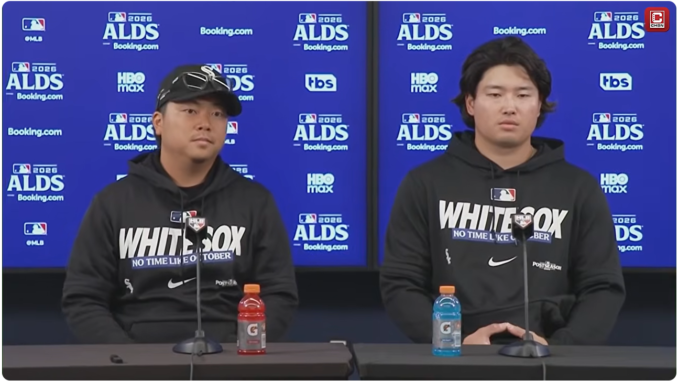
Human Auditor: Sean T. Cannon
AI-assisted analysis: ChatGPT, Claude, Gemini, and Grok
Transcription / diarization assistance: OpenAI, Google, Deepgram, Gladia, and pyannote
Languages: English ↔ Japanese
Domain: Professional Baseball / Postseason Media
Methodology: InterpreterOS Dual-Direction Interpretation Fidelity Audit
Executive Summary
InterpreterOS evaluates an interpreted interview as a complete communication exchange.
That means auditing both:
Reporter → Interpreter → Player
and
Player → Interpreter → Reporter / Audience
Translation fidelity is therefore not limited to whether the player’s Japanese words are represented accurately in English.
It also includes whether the player receives the reporter’s original question faithfully enough to understand its meaning, premises, technical content, scope, and intended opportunity to respond.
This distinction is particularly important in this Munetaka Murakami interview.
Much of Kenzo Yagi’s live interpretation successfully communicates the broad meaning of the conversation. Several exchanges are handled accurately despite the speed and difficulty of real-time interpretation.
However, the transcript also contains several significant divergences in both directions.
Some affect what English-speaking audiences hear Murakami say.
Others affect what Murakami is asked before he ever has an opportunity to answer.
The most consequential example concerns an explicit question about Murakami’s clubhouse leadership.
The reporter describes Murakami as someone who has been “a leader in the clubhouse” and asks about how he has occupied that role.
That leadership premise does not appear in the Japanese question delivered to Murakami. Instead, the interpreted question centers on Murakami’s personality becoming visible and how the team environment allows him to express himself.
Murakami consequently responds by thanking his teammates for welcoming him and allowing him to be himself.
The resulting English-language record therefore contains no substantive answer from Murakami about his leadership role.
The transcript supports an important distinction:
Murakami did not avoid answering a leadership question. He did not receive that leadership question in equivalent form.
Context: Real-Time Interpretation
This interpretation occurred live during a postseason press conference.
That matters.
Real-time consecutive interpreting is cognitively demanding. An interpreter may have only seconds to:
- understand the speaker,
- retain the information,
- reorganize it across two very different languages,
- preserve technical terminology,
- reproduce tone and intent,
- and immediately continue with the next exchange.
Unlike a written translator, a live interpreter generally cannot stop for extended research, replay every sentence, reconsider wording for several minutes, or revise a completed interpretation.
Some compression, restructuring, approximation, and loss of detail are therefore natural consequences of impromptu interpretation.
InterpreterOS does not evaluate a live interpreter against an unrealistic standard of perfect word-for-word reproduction.
The relevant question is:
Under real-time conditions, did both sides receive substantially the same information, intent, technical meaning, agency, and opportunity to communicate?
Minor stylistic differences and reasonable compression should not be treated as serious errors.
At the same time, the difficulty of live interpretation does not make consequential changes irrelevant.
When a leadership premise disappears, an entire subquestion is omitted, a baseball concept changes, or the central proposition of an answer is materially altered, the communicative effect remains important even when the circumstances make the error understandable.
The purpose of this audit is therefore not to assign motive or blame.
It is to document:
what was communicated, what changed or disappeared, and what each side ultimately received.
Methodology
Every interpreted exchange is evaluated as a full communication chain:
Original Question
→ Interpreted Question
→ Question Received by Player
→ Original Response
→ Interpreted Response
→ Meaning Received by Audience
The audit considers:
- semantic fidelity,
- completeness,
- question intent,
- question scope,
- premise preservation,
- agency,
- causality,
- certainty and qualification,
- baseball terminology,
- process versus outcome,
- register and tone,
- pragmatic meaning,
- speaker voice,
- and response opportunity.
A player cannot reasonably be evaluated against part of a question that was never transmitted.
Likewise, accurately interpreting a player’s response cannot restore information that disappeared from the original question.
PART I — QUESTION FIDELITY
Finding 1 — The Clubhouse Leadership Question
Original Reporter Question
The reporter says that the public has seen more of Murakami’s personality and asks him to explain how he has been:
“a leader in the clubhouse”
and how he has interacted with teammates in that role.
Japanese Question Delivered to Murakami
Yagi’s Japanese instead centers on Murakami’s personality coming out more and asks how the environment, including his teammates, enables him to express himself.
The explicit leadership premise is absent.
Murakami’s Response
Murakami says it is really thanks to his teammates, that they welcomed him from spring training, and that he feels grateful toward the team.
The English interpretation of that response largely preserves the gratitude and team-acceptance theme.
InterpreterOS Finding
QUESTION_PREMISE_OMISSION
QUESTION_INTENT_SHIFT
LEADERSHIP_OPPORTUNITY_LOSS
Severity: 4 — Major
Confidence: High
Why It Matters
The divergence occurs before Murakami answers.
The original question gives him an opportunity to discuss:
- leadership,
- clubhouse responsibility,
- influence,
- communication with teammates,
- and how he understands his role within the team.
The Japanese question instead gives him an opportunity to discuss:
- comfort,
- self-expression,
- personality,
- and acceptance by teammates.
Those are not equivalent response opportunities.
The original question also communicates something important to Murakami:
American reporters are observing him as a clubhouse leader.
That information itself does not reach him.
Finding 2 — “What Helped You Feel Comfortable?” Becomes “When?”
The reporter asks:
“What was it about this team that helped you feel comfortable early on?”
The question asks for a cause.
Yagi’s Japanese instead asks approximately when Murakami realized or noticed the team’s comfort and at what point he became aware of it.
Murakami then gives a timing-based response centered on spring training.
InterpreterOS Finding
QUESTION_INTENT_SHIFT
RESPONSE_OPPORTUNITY_LOSS
Severity: 3 — Meaningful
Confidence: High
The reporter asks what about the team created comfort.
Murakami receives a question closer to when he began feeling comfortable.
Finding 3 — Pitch Recognition Becomes Mechanics
A reporter asks what matters most when Murakami is hitting well:
“Is it the swing? Is it the pitch recognition?”
Those are two distinct baseball concepts.
The Japanese interpretation instead frames the alternatives approximately as:
swing or mechanics.
Pitch recognition concerns identifying and processing pitches.
Mechanics concerns physical execution of the swing.
InterpreterOS Finding
QUESTION_TECHNICAL_SUBSTITUTION
Severity: 3 — Meaningful
Confidence: High
Murakami therefore answers a somewhat different baseball question than the reporter asked.
Finding 4 — Half of the White Sox Signing Question Is Omitted
The reporter asks two substantive questions:
- Why Murakami chose the White Sox despite the team’s difficult preceding seasons.
- Whether he expected the White Sox to become this good this quickly.
The Japanese interpretation communicates essentially the first component only.
Murakami answers why reaching the postseason and winning together represents what he wanted to accomplish.
But he is not given an equivalent opportunity to answer whether he anticipated the team’s rapid improvement.
InterpreterOS Finding
QUESTION_SCOPE_OMISSION
RESPONSE_OPPORTUNITY_LOSS
Severity: 4 — Major
Confidence: High
A player’s failure to answer a subquestion should not be attributed to the player when that subquestion was never meaningfully transmitted.
Finding 5 — The September / Season Comparison Is Removed
The reporter asks whether the team looks different during the last three games compared with September and the season more broadly.
The Japanese question reduces this substantially to the idea that teammates believe they are currently playing their best baseball and asks what Murakami thinks.
InterpreterOS Finding
QUESTION_SCOPE_OMISSION
Severity: 3 — Meaningful
Confidence: High
The player is no longer specifically invited to explain what changed over time.
Finding 6 — “What Were You Feeling?” Becomes “What Were You Saying?”
After Murakami’s home run, the reporter asks:
“What were you feeling in that moment?”
The question is explicitly about Murakami’s emotional state.
Yagi asks:
どういうことを発してたんでしょうか?
Approximately:
“What were you saying?”
Murakami responds:
汚い言葉でした。
“They were dirty words.”
InterpreterOS Finding
QUESTION_INTENT_SHIFT
Severity: 4 — Major
Confidence: High
To an English-speaking viewer, Murakami’s response could appear disconnected from the reporter’s original question.
But he is answering the different question that actually reached him.
PART II — ANSWER FIDELITY
Finding 7 — Team Success in Houston Becomes More Individually Framed
Murakami says that in Houston the team came together and won, that it was not a bad series, and that the two days off may have helped him prepare or adjust well.
The English begins:
“I had a good series in Houston as well.”
and later introduces language about Murakami being comfortable and his feelings not changing between Houston and Cleveland.
InterpreterOS Finding
PLAYER_AGENCY_SHIFT
PLAYER_SELF_ASSESSMENT_SHIFT
Severity: 3 — Meaningful
Confidence: High
Murakami’s evaluation is more team-centered than the English version suggests.
Finding 8 — Intended Swing Becomes Successful Execution
Murakami explains that after previous matchups and a good first-at-bat hit to center, he was not particularly focused on anything special and intended to swing hard and fully through the ball.
The English says:
“I swung really clean.”
InterpreterOS Finding
PROCESS_RESULT_SHIFT
Severity: 2 — Minor
Confidence: High
The Japanese describes Murakami’s intended approach.
The English describes the quality of the resulting swing.
Finding 9 — Bullpen Trust Becomes “If We Score One Run, We Can Win”
Murakami says the team trusts that if the offense can find a way to score, the bullpen will hold opponents down.
He also says the lineup is functioning well and concludes that the team’s atmosphere is especially good.
The English says:
“If we score one run, I have so much confidence that we can win the game.”
and does not preserve Murakami’s concluding observation about the team’s atmosphere.
InterpreterOS Finding
OVERSPECIFICATION
BASEBALL_CONTEXT_LOSS
OMISSION
Severity: 3 — Meaningful
Confidence: High
“One run” is substantially more specific than Murakami’s original statement.
The original baseball idea is trust in the bullpen after the offense produces runs.
Finding 10 — Game 1 Being Important Becomes Series-Defining
Murakami says taking the initiative in a short postseason series is very important and that the team wanted to take Game 1.
The English says:
“It really… defines the outcomes of the series.”
and later introduces a “two game winning record.”
InterpreterOS Finding
INTENSIFICATION
ADDITION
Severity: 2–3 — Minor to Meaningful
Confidence: High
The English makes the significance of Game 1 more absolute than Murakami’s wording supports.
Finding 11 — “Home Runs at Home Are Special” Disappears
Asked about road versus home home runs, Murakami says the amount of cheering is different and adds:
ホーム球場で打つホームランは格別だなと思ってますね
A natural rendering is:
“Home runs at your home ballpark really are something special.”
The English instead says:
“If I do hit a home run at right field in Chicago, I mean, it goes absolutely nuts.”
and concludes that the major difference is the crowd noise.
InterpreterOS Finding
MAJOR_SEMANTIC_SHIFT
ADDITION
OMISSION
Severity: 4 — Major
Confidence: High
Murakami’s concluding proposition—that home-stadium home runs are especially meaningful—does not reach the English audience.
The interpretation also introduces information about a right-field home run that does not appear in the canonical Japanese transcript.
Finding 12 — Trust and Capability Become Mutual Respect
Murakami explains that each individual is trusted by others and possesses the ability or skill to live up to that trust.
He then describes the team’s postseason condition as evidence that players are trusted and are working in response to that trust.
The English interpretation instead centers on teammates having respect for one another, being mutually motivated, and looking toward the future as a team.
InterpreterOS Finding
MAJOR_SEMANTIC_SHIFT
COMPLEXITY_LOSS
Severity: 4 — Major
Confidence: High
The Japanese describes a relationship closer to:
trust → capability → responsibility / effort
The English shifts toward:
mutual respect → motivation → team outlook
Those are meaningfully different explanations of the team’s success.
Finding 13 — Team Process Becomes “Winning Mentality”
Murakami initially jokes that the atmosphere may be good simply because the team is winning and has not lost yet.
He then gives a more detailed explanation.
During the final month of the season, the team collectively emphasized preparing with the postseason in mind. Murakami also says that wins and losses happen and that players think about what they should do in the next game after losing.
The interpretation compresses much of this into:
“winning mentality attitude”
and a shared postseason mindset.
InterpreterOS Finding
COMPLEXITY_LOSS
PRAGMATIC_LOSS
Severity: 3 — Meaningful
Confidence: High
Murakami describes preparation, collective process, and how the team responds to setbacks.
The English becomes a more generalized motivational concept.
Finding 14 — Ishikawa’s Influence Is Expanded
Murakami describes veteran Masanori Ishikawa as someone who led by example.
He says Ishikawa maintained his desire to continue improving at baseball regardless of age and inspired younger players to feel that if Ishikawa was continuing to work, they had no excuse not to do the same.
Murakami ends by expressing gratitude.
The English adds:
“that’s how… I became who I am today”
and:
“I’m really happy that… I was able to be teammates with him.”
InterpreterOS Finding
ADDITION
VOICE / PERSONA SHIFT
Severity: 3 — Meaningful
Confidence: High
Those sentiments may be compatible with Murakami’s feelings, but the stronger autobiographical claim does not appear in the canonical transcript.
What the Interpretation Does Well
A fidelity audit should not treat every nonliteral rendering as an error.
Several exchanges preserve Murakami’s meaning effectively.
His gratitude toward teammates for welcoming him from spring training is substantially conveyed in English.
His explanation that success against elite pitchers requires essentially every aspect of his hitting to be functioning is also preserved reasonably well.
And his humorous explanation that he basically says “Let’s go” during mound gatherings because he cannot say much in English reaches the English audience with little meaningful loss.
These successful exchanges matter because InterpreterOS is not designed to find errors automatically.
A valid audit must be equally capable of concluding:
NO MATERIAL ERROR
or
ACCEPTABLE INTERPRETIVE VARIATION
when the evidence supports it.
The Central Finding
The most consequential finding in this interview is the clubhouse-leadership exchange.
The communication chain is:
REPORTER
Murakami’s personality has become more visible.
How has he been a leader in the clubhouse?
↓
INTERPRETED QUESTION
Your personality has become more visible.
How are you able to express yourself in this environment?
↓
MURAKAMI
My teammates welcomed me.
I am grateful to them.
↓
ENGLISH-LANGUAGE RECORD
Murakami discusses gratitude, acceptance, and being himself rather than defining his leadership role.
The difference is not simply that one Japanese phrase was translated imperfectly.
The available subject matter of Murakami’s answer changes before he speaks.
That is a different class of interpretation fidelity problem.
Leadership, Status and Communicative Asymmetry
The leadership example also illustrates a structural feature of interpreted professional sports interviews.
Murakami may possess substantially greater:
- public visibility,
- compensation,
- athletic responsibility,
- organizational investment,
- commercial importance,
- and leadership expectations
than the interpreter.
Yet during an English-Japanese exchange, he remains dependent on the interpreter for access to information delivered in English.
For the duration of that communication event, the interpreter occupies a critical information bridge.
That creates a communicative asymmetry that may be very different from the participants’ broader organizational status.
This observation does not establish improper motive or intentional filtering.
The transcript does not tell us why the leadership concept disappeared.
What can be established is narrower:
The reporter communicated a leadership premise.
The interpreter received it.
Murakami did not receive an equivalent leadership premise.
The communicative consequence exists regardless of intent.
Why Leadership Opportunity Loss Deserves Further Study
One example establishes an occurrence.
It does not establish a systemic pattern.
But it creates an important research question for future InterpreterOS audits:
Are leadership, authority, responsibility and player agency disproportionately weakened when Japanese-player interviews cross the language barrier?
If repeated audits show that questions about:
- leadership,
- responsibility,
- authority,
- mentoring,
- technical expertise,
- decision-making,
- or influence
are regularly transformed into questions about:
- comfort,
- gratitude,
- adaptation,
- personality,
- atmosphere,
- or fitting in,
then the resulting English-language record could portray Japanese players differently from the source-language interaction.
That hypothesis requires a substantially larger dataset.
It should be tested rather than assumed.
Interview-Level Findings
The most serious question-side findings are:
- Clubhouse leadership premise removed.
- “What helped you feel comfortable?” changed substantially toward “when.”
- Pitch recognition replaced with mechanics.
- Second half of the White Sox signing question omitted.
- September/season comparison removed.
- Emotional question changed into a question about what Murakami shouted.
The most serious answer-side findings are:
- Team-centered Houston assessment becomes more individually framed.
- Intended swing approach becomes successful execution.
- Bullpen trust becomes a specific one-run proposition.
- Game 1 importance becomes more absolute.
- Murakami’s statement that home home runs are special disappears.
- Trust, capability and responsibility become mutual respect.
- Detailed postseason preparation becomes “winning mentality.”
- Ishikawa’s influence is expanded into stronger autobiographical claims.
Provisional Fidelity Assessment
InterpreterOS scoring methodology is still being standardized.
The following numbers should therefore be treated as provisional rubric summaries, not scientifically precise measurements.
Question Channel
Intent Preservation: 72/100
Scope & Completeness: 68/100
Premise Preservation: 66/100
Baseball / Technical Fidelity: 76/100
Response Opportunity Preservation: 65/100
Question Fidelity: 71/100
The largest deductions come from the leadership omission, the missing second White Sox question, the emotional-question transformation, and several technical or scope changes.
Answer Channel
Semantic Fidelity: 84/100
Completeness: 80/100
Nuance & Pragmatics: 78/100
Register & Tone: 88/100
Baseball Fidelity: 84/100
Answer Fidelity: 83/100
Most broad answer meaning survives, but a smaller number of substantive propositions are changed, removed, or introduced.
Overall Mediated Interview
Provisional Fidelity Score: 77/100
The exact numerical score is less important than the documented findings.
The transcript supports this more defensible conclusion:
Most of Murakami’s interview remains understandable across languages, but several meaningful pieces of information change during interpretation. Some changes affect what English-speaking audiences hear Murakami say. Others affect what Murakami is given the opportunity to answer before he speaks.
Final Assessment
MIXED — MATERIAL FIDELITY LOSSES IN BOTH DIRECTIONS
Given the cognitive demands and speed of live interpretation, substantial portions of this press conference are handled successfully.
Most of Murakami’s broad message reaches the English-speaking audience.
The significant findings are therefore notable not because live interpretation contains imperfections—some loss is expected—but because a smaller number of differences materially change the information or communicative opportunity available to one side of the language barrier.
The most consequential discrepancies involve:
- removal of a leadership premise,
- omission of complete subquestions,
- substitution of baseball concepts,
- alteration of question intent,
- changes in team-versus-individual agency,
- simplification of Murakami’s reasoning,
- and additions not clearly present in his original responses.
The central InterpreterOS conclusion is:
Translation fidelity in an interview is not only about faithfully reproducing the subject’s words. It is also about faithfully transmitting the questions, information and opportunities that reach the subject in the first place.
Both directions determine the integrity of the interview.
Audit Attribution
Human audited by Sean T. Cannon
AI-assisted analysis:
ChatGPT — OpenAI
Claude — Anthropic
Gemini — Google
Grok — xAI
Transcription and diarization assistance:
OpenAI
Google
Deepgram
Gladia
pyannote
Multiple automated systems may be used to accelerate transcription, comparison, linguistic analysis and adversarial review.
Automated output is treated as supporting evidence rather than final authority.
Human review remains the final audit layer.
Editorial Standard
This audit evaluates the specific interpretation product contained in this interview.
It does not make a judgment about Kenzo Yagi’s character, motives, career, or overall professional ability.
No intentional omission or distortion is alleged from the transcript alone.
The findings describe observable differences between:
- what reporters asked,
- what Murakami received,
- what Murakami said,
- and what English-speaking audiences ultimately received.
Broader conclusions about interpreters, players, teams or organizations require repeated evidence across multiple interviews.
Canonical Transcript of the Interview
[00:03] Reporter #1: You just walked through the emotions of having your first postseason home run and getting to experience that with your teammates. You seemed pretty fired up as you rounded the bases and looking at your teammates.
[00:12] Kenzo Yagi: ポストシーズンでのホームランの振り返っての心境をお聞かせください。
[00:16] Munetaka Murakami: いや、まあ、すごく、はい、あの、先制点ほしかったんで、すごく嬉しかったですし、はい、あの、打てて良かったですね、はい。
[00:22] Kenzo Yagi: Well, I really wanted the first run at a very important game, so I’m just really happy that I got one off.
[00:29] Reporter #2: Cody, right. Just what was the approach during that fourth inning at bat?
[00:34] Kenzo Yagi: 4回の打席のアプローチについては、どんなアプローチをしたんでしょうか?
[00:37] Munetaka Murakami: ああ、いや、まあ、対戦も、え、シーズン中ありましたし、まあ、1打席目もいい形で、はい、センター前打てたので、まあ、何もこう特に意識せずに、はい、あの、強く振り抜こうと思ってました。
[00:48] Kenzo Yagi: I had a lot of matchups during the regular season, so in the first at bat I had a very clean hit, so I was very comfortable going to that at bat, and that was pretty much the approach, and I swung really clean.
[01:05] Reporter #3: Houston it didn’t really go your way. Was the difference in the series today the comfort level with the opponent?
[01:12] Kenzo Yagi: まあ、ヒューストンでも、あの、成績がうまくいかなかった部分もあったと思うんですけれども、あの、今回そのクリーブランドが相手っていうところが、あの、好調の要因になったのでしょうか?
[01:25] Munetaka Murakami: いや、それはないですね。まあ、あの、しっかり、はい、ヒューストンでもあの、チーム一丸となって勝てましたし、あの、悪いシリーズじゃなかったんで、まあ、それは、あの、はい、休み2日ってなりましたし、はい、いい調整ができたのかなと思ってますけど。
[01:34] Kenzo Yagi: Yeah, it wasn’t the opponent at all. I mean, I had a good series in Houston as well. As a team we were facing the same directions. We were playing as one and I think it was a great series. We had two days rest coming into this, let’s say, and I was really comfortable there, and it doesn’t really change what I felt in Houston or here.
[01:51] Reporter #1: It’s felt like we’ve gotten to see more of your personality, or the world’s gotten to see more of your personality, especially after the Houston series. Just can you pull back the curtain a little bit about the behind the scenes of how you’ve been a leader in the clubhouse and just been around your teammates in that way?
[02:17] Kenzo Yagi: まあ、あの、ヒューストンのシリーズの中でもこう村上選手のご自身の性格が表に出ることがすごく多かったなと思うんですけども、このようにこう、あの、自分自身を出せるっていう環境が、えと、チームメイト含めて、え、どういう風にこう自分自身を表に出すことができてますでしょうか?
[02:23] Munetaka Murakami: いや、もう本当チームメイトの、え、おかげですし、まあ、あの、スプリングトレーニングからすごくこう受け入れてくださって、はい、すごくありがたいなと思いながらプレイしてるので、あの、本当にこうチームに感謝したいなと思ってます。
[02:34] Kenzo Yagi: I really like to thank the team and the teammates. From spring training they were really welcoming and I was able to be myself a lot. So I just really like to, like I said, thank the teammates for enabling me to be who I am and who I am as a person.
[02:51] Reporter #4: Cody, what was it about this team that helped you feel comfortable early on?
[03:01] Kenzo Yagi: このチームのこう居心地の良さっていうところはいつごろ気づいたのか、そしてどのタイミングでそういう部分を気づかれたんでしょうか?
[03:05] Munetaka Murakami: いや、まあ、スプリングトレーニングこう、はい、やっていくうちに、まあ、1ヶ月ちょっとですかね、あの、WBCもあったんで、過ごさせてもらった中で、はい、あの、もうスプリングトレーニング時にはこう、はい、すごく感じてました。
[03:17] Kenzo Yagi: Yeah, I was like I said in spring training. I had a month off from the WBC but in the spring training the teammates welcomed me a lot and I was at home during that time. So it’s been the same since.
[03:31] Reporter #5: Good. Jordan. When you’re feeling good at the plate what is the most important thing? Is it the swing? Is it the pitch recognition? What is most important for you when you’re having success?
[03:37] Kenzo Yagi: こう、打席でのアプローチが良い時は、えと、スイングなのか、もしくはメカニックなのか、どういった部分が、あの、その好調に繋がってるんでしょうか?
[03:50] Munetaka Murakami: いや、まあ、全てにおいてですかね。まあ、やっぱ相手もこうすごい素晴らしいピッチャーが投げてくるので、まあ、こっちもこう何か1つ欠けててはね、こう完璧なスイングできないので、うん、まあ、あの、全てにおいてこう打席の中ではこう100%の状態で戦うことが1番大事かなと思ってますけど。
[04:01] Kenzo Yagi: Yeah, it’s pretty much everything. I mean, there’s tons of great pitchers out there and if one, let’s say, in mechanics or if one skill drops off I’m not going to be able to hit them. So it’s pretty much everything and then I have to do everything in 100% at the right way in order to hit those great pitchers. So I think, to answer your question, it’s just fully everything.
[04:21] Reporter #6: Good job. When you signed over the winter the White Sox had had some tough years before you came here. Why did you sign with the White Sox and did you think that your team would become this good this fast?
[04:35] Kenzo Yagi: ホワイトソックスに入団される前は、あの、苦しい厳しい、あの、成績が何年も続いていた中で、え、こうやってホワイトソックスへ入団を決めた理由っていうところは何だったんでしょうか?
[04:52] Munetaka Murakami: まあ、これが全てですね。こうやってポストシーズンに出て、あの、チーム一丸となって勝つっていうのが僕の目標でしたし、まあ、あの、はい、この今の現実がこう全てかなと思いますけど。
[04:58] Kenzo Yagi: Well, this is the reason why. As a team, the White Sox coming in as a postseason winning the series and then coming here in Cleveland, this is what I wanted to accomplish before I signed and that’s what I’m doing now. So this is pretty much everything.
[05:16] Reporter #7: Good. Scott. One of your teammates were talking about how you guys might be playing your best baseball of the year right now, which is obviously the perfect time for it. Do you see a difference in the team the last three games versus what you saw in September just throughout the season, which was a pretty good run for you guys overall?
[05:29] Kenzo Yagi: チームメイトの中でこう1年間で1番今いい野球ができてるという話が出てるんですけれども、その部分については、村上選手自身どうお考えでしょうか?
[05:46] Munetaka Murakami: いや、もう、僕も、あの、そう思いますね。やっぱりこうブルペンも、え、すごくこういい状態で、え、投げてくれてますし、まあ、何とかこう点を取れば抑えてくれるという、あの、信頼もありますし、まあ、あの、打線に関してもこうすごくいい打線として、あの、機能してるんじゃないかなと思ってます。まあ、あとはやっぱ雰囲気が1番いいですね、はい。
[05:57] Kenzo Yagi: I think so very much. We’re playing really the best baseball that we had in the season. The bullpen’s doing tremendous. If we score one run, I have so much confidence that we can win the game, which is really good. Um, batting aspect, we’re really, you know, doing our really good, let’s say, hitting. So in all aspects, I think we’re very much in a good state and we’re playing the best baseball in the season right now.
[06:23] Reporter #2: Just from the team perspective, just how important was it to strike first and win game one today?
[06:28] Kenzo Yagi: ここで第1戦を、え、えっと、まず、あの、1勝するっていうところの部分についてはどういう心境でしょうか?
[06:42] Munetaka Murakami: いや、もう、明日も休みですし、まあ、短期決戦での中でその先手っていうのはすごく大事になってくるので、え、まあ、あの、ここに来た時から何とか初戦は取りたいなと思ってたので、あの、こうして、まあ、勝つことができて、また明日休んでしっかり明後日もこう勝てるように、あの、自分たちの野球をしていきたいなと思います。
[06:53] Kenzo Yagi: The first game in the series is essential, very important, and I’m just really happy that we pulled this off. It really, you know, defines the outcomes of the series. So we’ll get the one day rest tomorrow. We’ll come back rested and then we’ll focus on winning again and try to get that, you know, two game winning record. Yeah.
[07:13] Reporter #8: Cody, when you hit the home run you turned and yelled toward the dugout. What were you feeling in that moment?
[07:22] Kenzo Yagi: まあ、ホームランを打った際に、あの、ダグアウトの方に、あの、感情を表したと思うんですけど、あの、どういうことを発してたんでしょうか?
[07:27] Munetaka Murakami: いや、もう、汚い言葉でした。
[07:30] Kenzo Yagi: I can’t really explain it in words right now but it was something a little bit dirty.
[07:35] Reporter #9: Go one more in English for Jordan. Is there a difference between hitting a big home run on the road versus hitting a big home run at home?
[07:44] Kenzo Yagi: あの、遠征でのこういう大きい、あの、意味の大きいホームランを打つのとホームでのホームランっていうところで何か違いなどはありますでしょうか?
[07:56] Munetaka Murakami: いや、まあ、声援の、はい、あの、量はやっぱ違いますね、はい、あの、まあ、シカゴでもこうたくさん何本か打ちましたけど、やっぱホーム球場で打つホームランは格別だなと思ってますね、はい。
[08:04] Kenzo Yagi: Yeah, the, you know, the sound of the audiences and the crowds is obviously different. If I do hit a home run at right field in Chicago, I mean, it goes absolutely nuts. So I think that’s the biggest difference is the noise. Yeah.
[08:24] Reporter #10: お疲れ様です。えっと、今日は客席ももう真っ赤で、歓声も、え、アウェイ感かなりあったと思うんですけど、その中でやるポストシーズンっていうのはいかがでした?
[08:31] Kenzo Yagi: There was a lot of red shirts in the stands. Um, how did you feel going into the game with such an away atmosphere?
[08:44] Munetaka Murakami: いや、もう、こうなることは、あの、予想はできてましたし、うん、まあ、特にこう何も、はい、僕は感じなかったんで、あの、まあ、こういう風になるシーズンの、まあ、最後っていうのは、はい、あの、ある程度こうイメージしながらやってたんで、それをこう上回ってくることはなかったんで、はい、普通にこう平常心でプレイができました。
[09:00] Kenzo Yagi: Well, I knew what I was coming into and this is the moment that I was preparing for the whole season. So I was not really expecting more. I knew what I was going into and that’s what I was being. I was very much myself during the game.
[09:21] Reporter #11: あの、野球の勝ち方っていろんなチームが、勝つチームの形というのは色々あると思うんですが、このチームは例えば控えがあるようで控えでない、じゃあ、もうほとんど10人全員が順番で均等に投げる。それだけチームがこうなんでしょう、全員が登場するチームっていうの、その中でこの気持ちっていうのはいかがでしょう?
[09:43] Kenzo Yagi: There’s a lot of different ways of winning a baseball game and the White Sox plays each and every player out accordingly. And how does that feel when you’re playing as a member of the White Sox?
[10:05] Munetaka Murakami: いや、もう、1人1人が、あの、はい、あの、いろんな人から信頼されてると思ってますし、それにこう応えるだけのこう技量もあると思ってますし、うん、まあ、本当にこう1人1人、はい、すごくいいモチベーションというか、あの、すごくいい形で、はい、ポストシーズン戦えてると思うので、まあ、それは本当にこうみんなの、はい、気持ちというか、みんなが信頼されて、みんながそれに対してこう努力してるこう証拠だとは思いますけど、はい。
[10:24] Kenzo Yagi: Each individual on the team has much respect for each other and they’re very much motivated with each other and the respect there is fully there. I think that way the feelings and how we, let’s say, look into the future as a team is what is showing and that’s why we were able to, let’s say, reach that success.
[10:45] Reporter #12: お疲れ様です。あの、シーズン終盤頃に、あの、不振を脱された頃に、あの、少し下半身を使ったトレーニングの方法を変えてそれの効果が出てるっていう話をされたと思うんですけど、以降、総じていい結果が出てるように見えるんですけど、やはり微調整はもちろんあると思うんですけど、その同じ流れで継続してそれがいい方向に繋がっているという感じですか?
[11:03] Kenzo Yagi: At the end of the season you have mentioned that you have put in some lower body work. Has that been helping the success that you are having now?
[11:11] Munetaka Murakami: まあ、そうですね、はい。
[11:14] Kenzo Yagi: Yes. Yes.
[11:22] Reporter #13: 村上さん、先ほどお話、雰囲気がいいというお話ありましたけど、ここに来てそのすごく雰囲気が良くなってる要因っていうのは村上さんなりにどういう理由があるとお考えですか?
[11:27] Kenzo Yagi: What do you think the reason of the great team atmosphere is occurring right now?
[11:36] Munetaka Murakami: 勝ってるからですかね。まあ、負けてないんでまだ、はい。でも、まあ、それはやっぱシーズンの最後1ヶ月はこうポストシーズンを意識して戦おうっていうのをこうチームの中で共有してましたし、まあ、本当みんな自然とこういい形で、まあ、入れてるので、まあ、これをこう、そうですね、まあ、勝ったり負けたりありますけど、こう負けた時にこう次の試合どうするかとか、まあ、いろんなことを考えながらみんな、あの、過ごしてるからだと思ってます、はい。
[12:01] Kenzo Yagi: I think the biggest part is because we’re winning. We haven’t lost yet and the biggest point is that we keep having that, let’s say, winning mentality attitude. I think each and everyone at the end of the season was facing the same direction with the same mindset of coming into the postseason with that winning attitude and I think that’s what is showing right now.
[12:22] Reporter #14: すみません雰囲気の話なんですけれども、あの、例えば内野でピッチャー交代時に集まってる時とかも、解ける時とかに村上さんがこう鼓舞してるような姿とかも拝見できるんですけど、それ自然に湧き上がるものなのか、何かこう自分なりの今のチームのそういう精神的な意味での役割みたいなの何か思ってるところがあるのか、何か教えてください。
[12:43] Kenzo Yagi: When there’s a pitching change I see all the infielders come in and you taking a leader role in the huddle. What are your approaches in that, let’s say, huddle and what are you mentioning to your teammates?
[13:02] Munetaka Murakami: うん。そうですね。まあ、レッツゴーって言ってるだけなんで、普通に、そんな深い言葉の意味はないですけど。はい、まあ、英語喋れないんで、まあ、それぐらい言っとこうかなっていう、あんま意味はないです。まあ、そうですね、はい、普通に、はい、行こうぜっていう、はい、感じです。
[13:15] Kenzo Yagi: Yeah, I’m not saying too much. I can’t speak English too much. So the only thing I’m saying is let’s go and I think that’s pretty much it.
[13:26] Reporter #15: すみません地区優勝、あ、おめでとうございます。え、まず、地区優勝をこう争ってたチームとの対戦になりましたけど、まあ、残念ながらちょっと負けてしまった中でこのガーディアンズとの対戦っていうのはご自身の中でこう対戦の意義ではないですけど、思う部分っていうのはありますか?
[13:42] Kenzo Yagi: What is your feeling coming into this game after you have fought for the division title and seeing the Guardians play for this division series?
[13:59] Munetaka Murakami: いや、まだ別の戦いだと思ってますし、こうポストシーズンで、まあ、はい、あの、やり返すっていうのはやり返すというか、そのどんな相手のチームでもこう勝ちに行くのはこう僕らの仕事ですし、うん、特に相手がガーディアンズだからといってこう意識することは僕はあんまなかったですし、チームはそれはまあ、みんなそうだと思いますけど。まあ、でも、はい、はい、勝つ意識はこうすごく、はい、どのチームにもあります、はい。
[14:19] Kenzo Yagi: Yeah, obviously it’s a different feeling coming into the postseason but as a thought, I mean, the approach of, let’s say, winning that baseball game hasn’t changed. I mean, if it’s the Guardians it doesn’t really matter. It’s all opponents out there in the postseason that we have to get through in order to get that, you know, final spot. So that approach doesn’t change and it doesn’t really matter which team comes in. We just try to win as much as possible.
[14:43] Reporter #13: すみません、長くなって。先輩の石川さんが引退されたことについて、村上さんがヤクルトにいた頃こう投手打者の違いあれど、こうどういうプロフェッショナルを学んだとかそういったものがあれば教えてください。
[14:53] Kenzo Yagi: In your career in Japan you had a very good relationship with Ishikawa san, a pitcher. What have you learned from him and his approach to baseball?
[15:15] Munetaka Murakami: いや、もう、はい、あの、すごく背中でこう引っ張ってくれる、え、大きな先輩でしたし、まあ、本当にこう野球の向上というか、あの、野球に対してのこううまくなりたいっていう気持ちがこう何歳になっても常にこう持ち続けていましたし、まあ、石川さんがやるなら僕らもやるしかないっていうぐらい、あの、引っ張ってくれたので、本当に感謝してますね、はい。
[15:23] Kenzo Yagi: He was showing everything and every single teammate how to play baseball and how to approach baseball by his back. How to improve as a player each and every single day. He showed that and that’s how, you know, we looked up to him a lot and that’s how, you know, I became who I am today and that’s why we have so much respect towards him and I’m really happy that, you know, I was able to be teammates with him.
Leave a Reply