
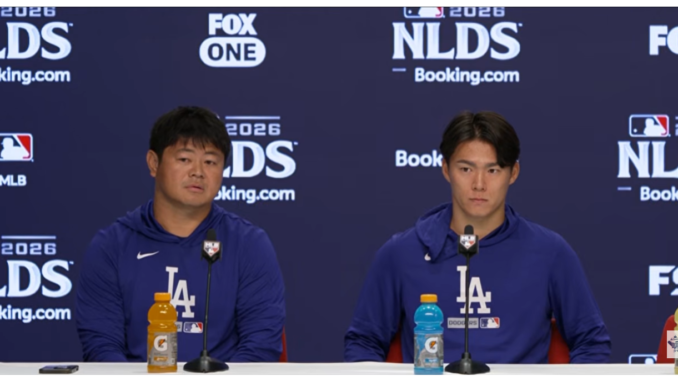
Player: Yoshinobu Yamamoto
Interpreter: Hiro Sonoda
Human Auditor: Sean T. Cannon
AI-assisted analysis: ChatGPT, Claude, Gemini, and Grok
Transcription / diarization assistance: OpenAI, Google, Deepgram, Gladia, and pyannote
Languages: English ↔ Japanese
Domain: Professional Baseball / Postseason Media
Methodology: InterpreterOS Dual-Direction Interpretation Fidelity Audit — Rubric V2
Official Score Summary
Question Fidelity: 62/100
Answer Fidelity: 82/100
Interpretation Fidelity: 72/100
Bilingual Coverage: 100/100
Overall Interview Integrity: 72/100
Verdict
MIXED — STRONGER ANSWER FIDELITY, BUT MATERIAL QUESTION-SIDE LOSSES
Hiro Sonoda generally communicates Yoshinobu Yamamoto’s answers effectively.
The more serious weakness in this interview is the question channel.
Several detailed reporter questions are reduced to substantially narrower questions, and in some cases important premises or entire requested dimensions disappear.
That matters because interpretation fidelity is not only about translating the player’s answer.
It also determines:
what the player was actually asked
and, when Japanese reporters are speaking,
what the English-speaking audience understands the player is responding to.
Context: Live Interpretation
This was real-time interpretation.
Some compression is inevitable and should not automatically be considered an error.
InterpreterOS distinguishes between:
efficient compression
and
material information loss.
A shorter question can remain fully faithful.
But if shortening removes the actual concept being investigated—such as physical peaking, technical preparation, stadium atmosphere, or a complete second part of a question—the resulting communication is no longer equivalent.
PART I — QUESTION FIDELITY
Finding 1 — Dave Roberts / Mark Prior Follow-Up Is Lost
Katie Woo asks:
- how Yamamoto learned of the pitching plan;
- whether he had conversations with Dave or Mark about it.
The Japanese delivered to Yamamoto asks essentially only how he learned about the pitching schedule.
The Dave/Mark component disappears.
Finding
QUESTION_SCOPE_OMISSION
RESPONSE_OPPORTUNITY_LOSS
Severity: 3 — Meaningful
Yamamoto is not given the same opportunity to discuss communication with the coaching staff.
Finding 2 — “How Did You Stay Fresh?” Becomes a General Postseason Question
Sonja Chen references Yamamoto’s heavy workload in the previous postseason and asks what he learned specifically about:
keeping himself fresh enough to pitch so many innings.
Sonoda’s Japanese asks more generally what Yamamoto learned from last postseason and how he intends to approach this postseason.
What Changes
The original question focuses on:
workload → recovery/freshness → ability to sustain innings
The interpreted question becomes:
previous postseason experience → approach this postseason
Finding
QUESTION_INTENT_SHIFT
TECHNICAL DETAIL LOSS
Severity: 4 — Major
The broad subject remains postseason experience.
The actual performance-management question does not.
Finding 3 — Relief and Short Rest Are Generalized
The reporter asks whether Yamamoto would be prepared to:
- pitch in relief as he did previously,
- or work on shorter rest.
Sonoda asks more generally whether Yamamoto could adapt if asked to take on that kind of role.
Finding
QUESTION_SCOPE_COMPRESSION
Severity: 3 — Meaningful
The willingness-to-adapt concept survives, but the specific pitching scenarios become less explicit.
Finding 4 — Physical Peaking Question Is Fundamentally Changed
This is one of the clearest question-side losses.
Reporter
Fabian Ardaya asks:
how much Yamamoto’s training is geared toward peaking physically at this time of year, particularly when other pitchers may not be in as strong a physical position.
This is a question about training philosophy and periodization.
Japanese Delivered to Yamamoto
Sonoda asks approximately:
“With your training methods, how physically prepared are you right now?”
What Changes
The reporter asks:
Is your training designed so that you peak now?
Yamamoto receives:
How good is your physical condition now?
Those are fundamentally different questions.
One asks about cause and preparation design.
The other asks about current condition.
Finding
QUESTION_INTENT_SHIFT
TECHNICAL QUESTION LOSS
RESPONSE_OPPORTUNITY LOSS
Severity: 4 — Major
Yamamoto is never given the opportunity to explain whether his training program is deliberately structured around reaching a physical peak in October.
Finding 5 — Delivery / Mechanical Work Is Removed
Ardaya asks whether the longer period between actual games gave Yamamoto time to work on specific things:
“whether it be with your delivery or anything like that.”
Sonoda asks whether Yamamoto changed any part of his preparation.
Finding
TECHNICAL DETAIL LOSS
Severity: 3 — Meaningful
The reporter specifically invites Yamamoto to discuss pitching mechanics or delivery.
That opportunity becomes a generic preparation question.
Finding 6 — Chris Sale / Tied Series Question Is Preserved
The reporter asks what Yamamoto thinks about facing Chris Sale with the series tied.
The Japanese preserves both the 1–1 situation and Sale matchup.
Finding
NO MATERIAL ERROR
PART II — JAPANESE REPORTER QUESTION FIDELITY
The Japanese-media portion remains available to the English audience, which is a major coverage strength.
However, coverage and fidelity are not the same thing.
Sonoda continues speaking English, but some Japanese questions are substantially reduced before the English audience hears them.
Finding 7 — First Sale Question Is Summarized After Yamamoto Answers
The Japanese reporter asks what kind of pitching Yamamoto believes he needs in order to win against Sale.
Yamamoto answers directly in Japanese.
Sonoda then tells the English audience what the question was and summarizes Yamamoto’s answer afterward.
Finding
DELAYED QUESTION ACCESS / ACCEPTABLE WITH MINOR LOSS
The communication eventually reaches the audience, but not in normal question → answer order.
Finding 8 — Previous Sale Matchup Context Is Reduced
The Japanese reporter notes that Yamamoto pitched well in the August matchup while Sale threw a complete game and won, then asks about Yamamoto’s impressions and feelings from that game.
Sonoda asks essentially what Yamamoto remembers or thought about facing Sale in August.
Finding
QUESTION_PREMISE COMPRESSION
Severity: 2 — Minor
The central subject survives, but the complete-game-loss context is removed.
Finding 9 — Stadium Atmosphere Question Is Not Translated Into English
This is another major question-side finding.
Japanese Reporter
The reporter gives detailed context:
- Yamamoto has pitched three previous games there,
- all on the road,
- he owns a 0.55 ERA,
- opponents have hit .158,
- and asks how comfortable he feels pitching there.
The reporter then adds an entirely separate dimension:
the stadium has a distinctive atmosphere and unified, passionate support, and asks what Yamamoto experiences from the mound.
English Interpretation
Sonoda says:
“You faced Braves three times in the past, and then your ERA was .55, and then opponent hitting average was .158, and then what was your impression, and then…”
The atmosphere portion of the question never reaches the English audience.
Yamamoto’s Japanese Response
Yamamoto nevertheless answers both dimensions.
He talks about his strong results and condition, then says the stadium atmosphere is always energetic, the fans are passionate, and he really enjoys playing there.
English Audience Experience
English listeners suddenly hear Sonoda talking about:
“the fans here” and “the atmosphere”
despite never having been told that the reporter asked about those subjects.
Finding
QUESTION_SCOPE_OMISSION
COMPLETE SUBQUESTION LOSS
CONTEXT LOSS
Severity: 4 — Major
This is precisely why InterpreterOS must audit Japanese reporter questions into English as well.
The player’s answer cannot be understood fully if the audience does not know what he was responding to.
Finding 10 — Ohtani Squad-Game Question Loses Significant Context
The reporter says Dave Roberts described the simulated matchup in a way that suggested Yamamoto “won,” then asks:
- what Yamamoto felt facing Ohtani,
- what he learned,
- his impressions,
- and how many pitches he threw.
Sonoda communicates:
- that Yamamoto faced Ohtani,
- what he learned,
- and the pitch count.
The manager’s framing and some of the requested personal impressions disappear.
Finding
QUESTION_SCOPE_OMISSION
PREMISE LOSS
Severity: 3 — Meaningful
Finding 11 — Advice Frequency / Game 3 Question Is Reduced
The reporter asks whether Ohtani frequently gives Yamamoto this kind of advice or whether this was the first time he had received so much advice.
The reporter then asks how Yamamoto feels approaching Game 3 with the series tied 1–1.
Sonoda reduces this to approximately:
- does this happen often between you?
- what do you think about tomorrow’s game?
Finding
QUESTION_SCOPE COMPRESSION
Severity: 3 — Meaningful
The broad concepts survive, but the specificity of both subquestions weakens.
Finding 12 — Third Postseason Question Is Generally Faithful
The reporter asks whether Yamamoto feels mentally and physically better prepared entering his third postseason than during the previous two.
Sonoda preserves the comparison reasonably well.
Finding
GENERALLY FAITHFUL
Finding 13 — Cross-Context Mentality Question Is Mostly Preserved
The final reporter asks whether Yamamoto is able to maintain essentially the same mindset across:
- regular season,
- international competition,
- postseason,
- and World Series-level games.
Sonoda conveys the general comparison across different types of games.
Finding
MINOR COMPRESSION
Question Fidelity
62/100
Dominant Pattern
The major weakness of this interview is:
specific reporter question → broader, simpler question
The topic frequently survives.
The reporter’s actual investigative purpose does not always survive.
The largest examples involve:
- postseason workload and staying fresh,
- physical peaking,
- mechanical/delivery work,
- stadium atmosphere,
- coaching-staff conversation,
- and multi-part Japanese-media questions.
PART III — ANSWER FIDELITY
Finding 14 — Opening Answer Is Substantially Faithful
Yamamoto explains that he was not with the team in San Francisco and was not told directly, but once his start was set he mentally switched into preparation mode.
Finding
GENERALLY FAITHFUL
Finding 15 — Interpreter Inserts His Own Role
Yamamoto says he was in Los Angeles and received communication about the schedule.
Sonoda says:
“I got a text message and I told him.”
This introduces the interpreter’s own role into what should be Yamamoto’s interpreted response.
Finding
INTERPRETER ADDITION / ROLE SHIFT
Severity: 3 — Meaningful
The information may be factually accurate.
It is still not equivalent to simply interpreting Yamamoto’s answer.
Finding 16 — Previous Postseason Experience Is Mostly Preserved
Yamamoto says last year’s postseason experience will help but that his mindset remains essentially the same: focus on one game at a time.
Finding
MINOR NUANCE LOSS
Finding 17 — Flexible Role Answer Is Faithful
Yamamoto says he is preparing to do whatever is necessary and will focus on the game in front of him.
Finding
NO MATERIAL ERROR
Finding 18 — Physical Condition Answer Is Faithful
Yamamoto says he believes he has arrived in good form and that his physical condition is very good.
Sonoda communicates that accurately.
Finding
GENERALLY FAITHFUL
Importantly, however, this does not repair the preceding question shift.
Yamamoto gives a perfectly reasonable answer to the question he received.
The reporter had originally asked something different.
Finding 19 — Preparation / Simulated Game Answer Is Mostly Faithful
Yamamoto says he has basically not changed anything and treated the previous week’s simulated game as an actual game.
The central meaning survives.
Finding
GENERALLY FAITHFUL
Finding 20 — Sale Answer Is Highly Faithful
Yamamoto calls Sale a great pitcher and says he will focus on his own job.
The English preserves the point closely.
Finding
NO MATERIAL ERROR
Finding 21 — August Loss Answer Is Faithful
Yamamoto says losing was frustrating, but tomorrow is a new game and he will focus on it.
Sonoda communicates this accurately.
Finding
GENERALLY FAITHFUL
Finding 22 — Braves Answer Loses “I Really Like Playing Here”
Yamamoto says his strong past results may simply reflect being in good condition.
He then praises the energetic atmosphere and passionate fans and says:
“I really like playing here.”
Sonoda communicates the good condition and passionate atmosphere but does not preserve that final personal statement.
Finding
OMISSION
Severity: 2 — Minor
Finding 23 — Ohtani’s Advice Loses Most of Its Substance
Yamamoto says:
- he threw approximately 70 pitches,
- Ohtani gave him a lot of advice,
- some came from a batter’s perspective,
- and some concerned psychological/mental aspects.
Sonoda says essentially:
Ohtani “gave me some advice from his perspective.”
Finding
COMPLEXITY LOSS
CONCEPTUAL OMISSION
Severity: 3 — Meaningful
English listeners learn that Ohtani offered advice.
They do not learn what made the advice substantive or unusual.
Finding 24 — Game 3 Momentum Point Is Lost
Yamamoto explains that he and Ohtani often talk baseball because their lockers are near each other.
He says this was their first direct matchup since joining the Dodgers.
He then says Game 3 is extremely important because, with the series tied 1–1, it can substantially affect the flow/momentum of the series.
Sonoda preserves most of the Ohtani relationship and Yamamoto’s desire to win but does not preserve the series-momentum explanation.
Finding
COMPLETENESS LOSS
Severity: 2 — Minor
Finding 25 — Third Postseason Answer Is Faithful
Yamamoto says he cannot determine which of his three postseasons represents the best condition but that he is prepared.
Sonoda preserves that meaning.
Finding
GENERALLY FAITHFUL
Finding 26 — Postseason Mentality Loses Yamamoto’s Coping Strategy
Yamamoto says he tries to approach every game with the same mentality and treat each game as important.
He acknowledges that major October games naturally produce some emotional change.
His important final point is that even when that happens, he tries to perform as normally as possible.
Sonoda preserves:
- the consistent general mentality,
- and the fact that postseason games feel somewhat different.
But Yamamoto’s concluding strategy—trying to maintain normal performance despite those feelings—does not clearly survive.
Finding
REASONING LOSS
COMPLETENESS LOSS
Severity: 3 — Meaningful
Finding 27 — Final Follow-Up Is Faithful
The reporter asks why Yamamoto can maintain that mentality.
Yamamoto says:
“Because I always pitch with the same mentality.”
Sonoda communicates this accurately.
Finding
NO MATERIAL ERROR
Answer Fidelity
82/100
Yamamoto’s central meaning is usually represented reasonably well.
The important losses are concentrated in:
- detailed explanations,
- specific personal statements,
- Ohtani’s advice,
- and Yamamoto’s reasoning about maintaining normal performance under postseason pressure.
Interpretation Fidelity
72/100
Question Fidelity: 62/100
Answer Fidelity: 82/100
The result reflects a substantial asymmetry:
Sonoda translates Yamamoto better than he translates many of the questions surrounding Yamamoto.
That matters because accurate answers cannot compensate for questions whose substance never reached the player or the other-language audience.
Bilingual Coverage
100/100
Both the English-media and Japanese-media portions remain available across the language barrier.
This is a meaningful strength.
But complete coverage does not mean perfect fidelity.
The Japanese Braves-atmosphere exchange demonstrates the distinction clearly:
The exchange was translated.
But the English audience did not receive the full question.
Therefore:
Coverage = complete.
Question fidelity = materially incomplete.
Overall Interview Integrity
72/100
No coverage penalty applies because the complete substantive press conference remains bilingually accessible.
The deduction comes from actual fidelity losses.
Strongest Question-Side Finding
The physical-peaking question
The reporter asks whether Yamamoto’s training is specifically structured so that he reaches a physical peak in October.
Yamamoto is instead asked essentially how physically prepared he currently feels.
That is not ordinary compression.
It changes:
training methodology
into
current physical condition.
Second Major Question-Side Finding
The stadium-atmosphere question
The Japanese reporter explicitly asks Yamamoto how he experiences the distinctive atmosphere and passionate support from the mound.
That portion never reaches the English audience as part of the translated question.
Yamamoto answers it anyway.
As a result, the English audience hears an answer about the atmosphere without being told why Yamamoto is talking about it.
Strongest Answer-Side Finding
Yamamoto describes extensive advice from Ohtani involving:
- a batter’s perspective,
- and psychological considerations.
The English audience receives only the much more generic idea that Ohtani gave him:
“some advice from his perspective.”
Final Assessment
72/100 — MIXED FIDELITY
Hiro Sonoda generally preserves Yoshinobu Yamamoto’s answers substantially better than he preserves the full scope of reporter questions.
The interview’s primary weakness is therefore not wholesale mistranslation of Yamamoto.
It is question reduction.
Detailed questions involving:
- training philosophy,
- physical peaking,
- workload management,
- mechanics,
- atmosphere,
- coaching communication,
- and multi-part contextual framing
are sometimes simplified into much broader questions.
That changes what Yamamoto is given the opportunity to discuss and, in Japanese-media exchanges, can also change what the English audience understands Yamamoto to be answering.
The complete press conference remains bilingually accessible.
But accessibility alone is not fidelity.
Audit Attribution
Human audited by Sean T. Cannon
AI-assisted analysis: ChatGPT, Claude, Gemini, and Grok
Transcription / diarization assistance: OpenAI, Google, Deepgram, Gladia, and pyannote
Human review remains the final audit layer.
Leave a Reply